Best CMS for Small Business Websites in 2026
Choosing the best CMS for small business websites is one of the most important decisions you’ll make when building your online presence. In today’s competitive digital landscape, your website is more than just a digital brochure it’s your 24/7 salesperson, marketing platform, and first impression for potential customers.
Whether you’re a startup, retailer, healthcare provider, educational institute, manufacturer, or service-based business, your website should be easy to manage, fast, secure, and optimized for search engines. That’s exactly where a Content Management System (CMS) plays a crucial role.
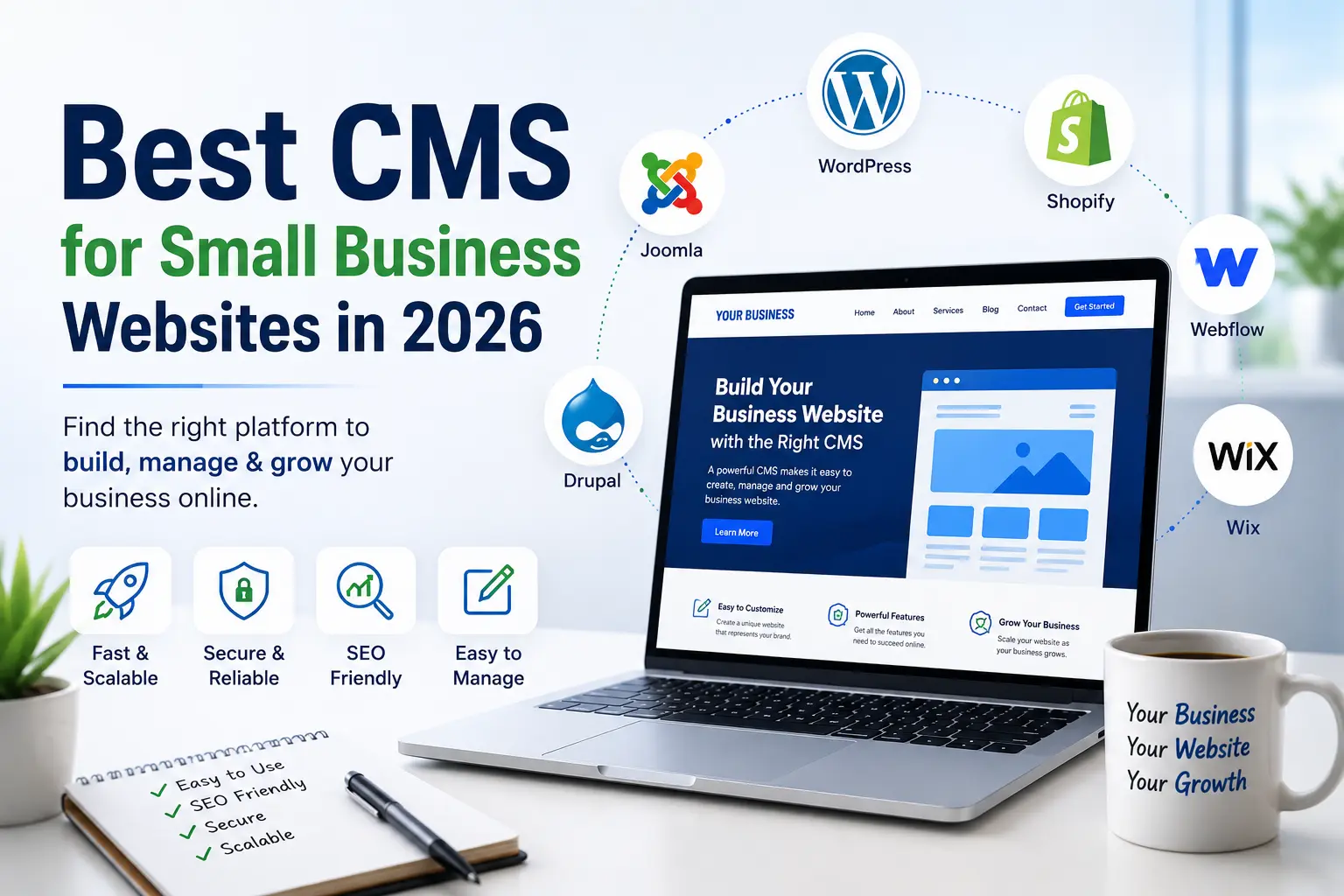
The best CMS for small business websites allows you to create and manage content without extensive coding knowledge while providing the flexibility to grow as your business expands. However, with platforms like WordPress, Shopify, Webflow, Wix, Joomla, and Drupal available today, choosing the right one can feel overwhelming.
In this guide, we’ll compare the leading CMS platforms, explain their advantages and limitations, and help you choose the best CMS for small business websites based on your goals, budget, and future growth plans.
What Is a Content Management System (CMS)?
A Content Management System (CMS) is software that allows you to create, edit, organize, and publish website content without writing code for every update.
Instead of depending on a developer whenever you need to modify a page, publish a blog, upload images, or update business information, a CMS provides an easy-to-use dashboard that gives you complete control over your website.
A modern CMS allows businesses to:
- Create and edit website pages
- Publish blogs and articles
- Upload images and videos
- Manage products and services
- Improve search engine optimization (SEO)
- Add users with different permission levels
- Integrate third-party applications
- Keep websites secure and updated
For growing businesses, choosing the best CMS for small business websites means lower maintenance costs, greater flexibility, and easier website management.
Why Choosing the Best CMS for Small Business Websites Matters
Your website is one of your most valuable marketing assets. The CMS powering your website directly affects its speed, SEO performance, security, scalability, and overall user experience.
Choosing the wrong platform can result in poor search engine rankings, expensive redesigns, limited customization, and higher maintenance costs.
A reliable CMS helps your business:
- Improve website performance
- Publish content quickly
- Rank better on Google
- Enhance website security
- Support future business growth
- Integrate with CRM and marketing tools
- Deliver a better customer experience
Investing in the best CMS for small business websites today ensures your website continues to meet your business needs as you grow.
Key Features to Look for in a CMS
Before selecting a platform, evaluate your business requirements carefully.
Easy Content Management
Choose a CMS that allows you and your team to update content without technical expertise.
SEO Capabilities
The best CMS for small business websites should support SEO-friendly URLs, meta titles, schema markup, XML sitemaps, image optimization, and fast-loading pages.
Security
Look for platforms that offer regular updates, SSL compatibility, backups, and secure user management.
Scalability
As your business grows, your CMS should easily support additional pages, products, users, and new functionality without requiring a complete rebuild.
Third-Party Integrations
Your CMS should integrate smoothly with payment gateways, CRM software, email marketing platforms, analytics tools, and other business applications.
Best CMS for Small Business Websites Compared
WordPress
WordPress continues to be the best CMS for small business websites because of its flexibility, affordability, and excellent SEO capabilities.
It powers more than 40% of websites worldwide and supports businesses across almost every industry.
WordPress is ideal for:
- Service businesses
- Healthcare clinics
- Educational institutions
- Manufacturing companies
- Consultants
- Travel agencies
- Blogs
- Corporate websites
With thousands of themes and plugins available, WordPress can easily scale as your business grows, making it one of the most future-proof CMS platforms available.
Shopify
If your business focuses primarily on selling products online, Shopify is one of the best CMS platforms available. It is built specifically for eCommerce and includes everything you need to manage an online store, from product listings and inventory tracking to secure payment gateways and order management.
Shopify is ideal for retailers, fashion brands, electronics stores, and businesses that want a simple yet powerful eCommerce solution. While it offers fewer customization options than WordPress, it requires less technical maintenance and provides excellent reliability for online selling.
Webflow
Webflow combines professional web design with a flexible Content Management System, making it a popular choice for creative agencies, startups, and businesses that prioritize branding and modern website design.
It allows designers to build visually stunning, responsive websites without sacrificing performance. If design flexibility is your highest priority, Webflow is worth considering.
Wix
Wix is designed for beginners who want to create a website quickly using a drag-and-drop interface. It is easy to use and offers a wide range of templates for different industries.
Wix is suitable for freelancers, consultants, and small local businesses. However, businesses planning significant growth may eventually outgrow the platform and require a more scalable CMS.
Joomla
Joomla is a versatile CMS that offers advanced user management, multilingual support, and greater flexibility than most beginner website builders.
It is well suited for medium-sized businesses that require more customization while still wanting an easy-to-manage platform.
Drupal
Drupal is an enterprise-level CMS known for its advanced security and scalability. It is commonly used by government organizations, universities, and large enterprises that manage complex websites.
Although Drupal is extremely powerful, it generally requires technical expertise and is more suitable for large organizations than small businesses.
How to Choose the Best CMS for Small Business Websites
Selecting the best CMS for small business websites depends on your business goals rather than simply choosing the most popular platform.
Before making your decision, ask yourself:
- Will I regularly publish blogs and articles?
- Do I need an online store?
- Is SEO important for my business?
- Will my website grow over the next few years?
- Do I need custom functionality or integrations?
- Can my team easily manage the website?
For most service-based businesses, healthcare providers, educational institutions, and corporate companies, WordPress offers the ideal balance of flexibility, affordability, and SEO performance. Businesses focused on online selling may prefer Shopify, while creative businesses often benefit from Webflow’s design capabilities.
Common Mistakes to Avoid
Many businesses choose a CMS based only on cost or popularity. This often leads to unnecessary limitations and expensive redesigns later.
Avoid these common mistakes:
- Choosing a platform without considering SEO
- Ignoring future business growth
- Overlooking website security
- Selecting a CMS with limited customization
- Failing to consider ongoing maintenance costs
- Not checking integration options before development
Choosing the best CMS for small business websites from the beginning can save both time and money in the long run.
Frequently Asked Questions
Which CMS is best for SEO?
WordPress is widely considered the best CMS for SEO because it offers complete control over on-page optimization, technical SEO, plugins, and website performance.
Which CMS is best for beginners?
Wix and Shopify are excellent choices for beginners because they provide intuitive interfaces and require minimal technical knowledge.
Can I change my CMS later?
Yes, but migrating a website can be time-consuming and may affect your SEO if not planned properly. Choosing the right CMS from the start is always the better approach.
Is WordPress still the best CMS in 2026?
Yes. WordPress continues to be one of the most trusted CMS platforms due to its flexibility, scalability, affordability, and strong SEO capabilities.
Final Thoughts
Choosing the best CMS for small business websites is about more than building a website—it’s about creating a digital platform that supports your marketing, customer engagement, and long-term business growth.
Every CMS has its strengths, but the right choice depends on your business requirements, budget, and future plans. For most businesses, WordPress remains the preferred option because it combines excellent SEO capabilities, flexibility, scalability, and a vast ecosystem of themes and plugins. However, businesses focused on eCommerce or highly visual branding may find Shopify or Webflow better suited to their needs.
Taking the time to evaluate your requirements before selecting a CMS will help you avoid costly migrations and ensure your website continues to support your business as it grows.
Why Choose Tantrata Solutions?
Choosing the best CMS for small business websites is only the first step. Building a website that attracts visitors, ranks well on Google, and generates leads requires the right strategy and technical expertise.
At Tantrata Solutions, we specialize in developing high-performance websites that are secure, responsive, SEO-friendly, and tailored to your business goals. Our services include WordPress Development, Shopify Development, Custom CMS Solutions, Website Design, Website Redesign, SEO Optimization, Website Maintenance, API Integrations, Mobile App Development, and Digital Marketing.
Rather than recommending a platform simply because it’s popular, we take the time to understand your business, target audience, and future growth plans. This enables us to recommend the most suitable CMS and develop a website that delivers long-term value.
Whether you’re launching a new website or planning a redesign, our team is committed to creating digital solutions that help your business grow. If you’re unsure which CMS is right for your business, Tantrata Solutions is here to guide you every step of the way and build a website that supports your success today and into the future.




Leave a Reply